Meridian Artifact ID
Embedding NFC chips in artwork to fight forgery. A project born from watching too many auction scams.
I bought a fake painting once. Cost me more than I want to admit.
It wasn't a famous work-just a small piece by an emerging African artist I admired. The seller had a certificate of authenticity. Looked official. Embossed paper, signatures, the whole thing.
Two years later, I saw the exact same painting for sale at another gallery. Same artist, same title, same dimensions. But the provenance was different.
I'd been scammed. The certificate was forged.
That's when I started thinking: What if authentication wasn't a piece of paper you could Photoshop?
The Idea: Make Forgery Cryptographically Impossible
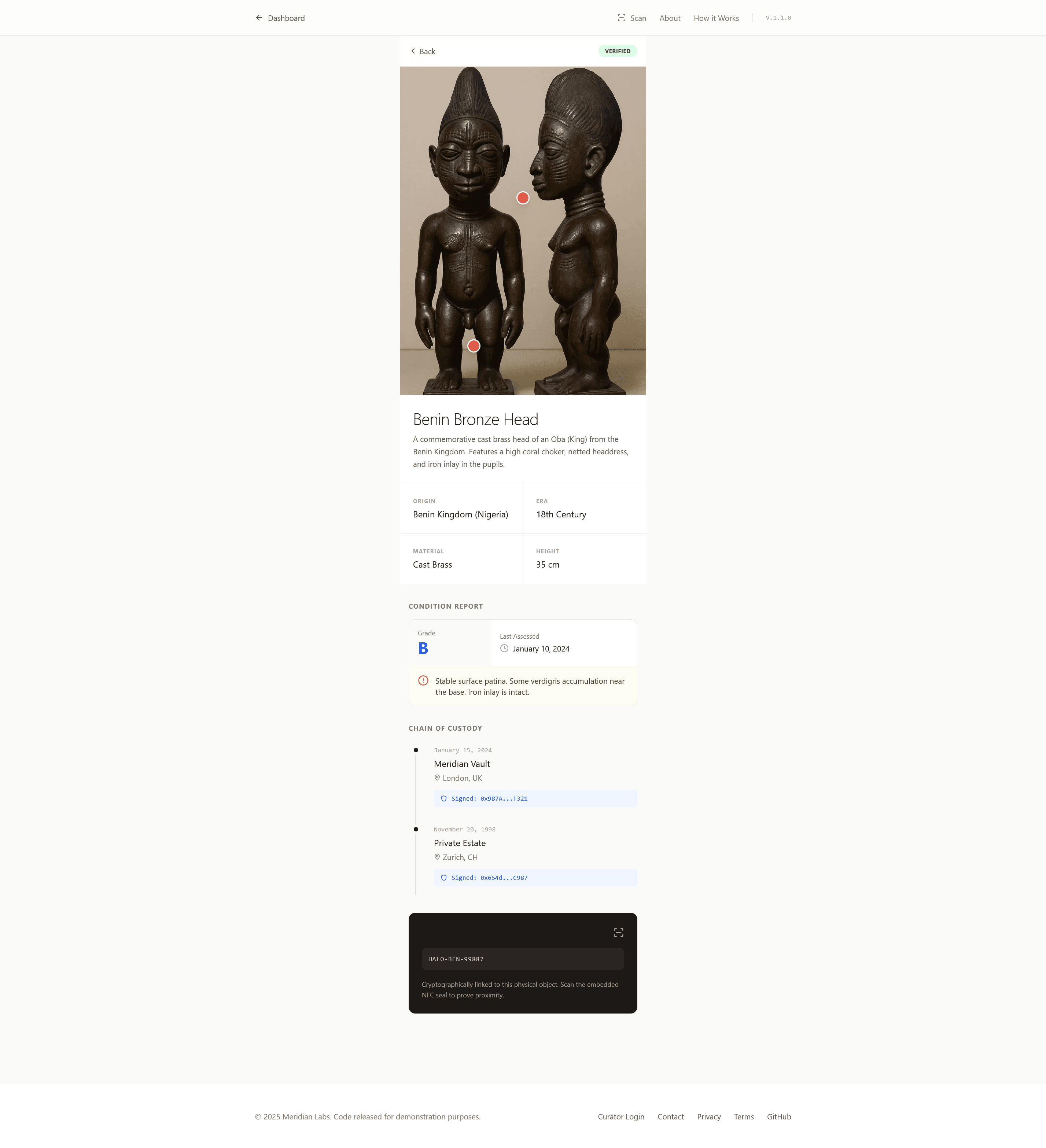
The core concept is simple: embed a tamper-proof NFC chip into the artwork (or its frame/mount), and link that chip to an immutable blockchain record.
When someone scans the chip with their phone, it generates a unique cryptographic signature that proves: "This is the real physical object, not a replica."
No expert opinions. No subjective authentication. Just math.
Building the First Prototype (In My Kitchen)
I ordered 50 NFC chips from Alibaba. Cheap enough to experiment with. No idea what I was doing.
First attempt: I tried embedding a chip directly into the back of a wooden panel painting. Used super glue. The glue damaged the chip's antenna. Dead on arrival.
Second attempt: Embedded the chip in the frame instead of the artwork. Used epoxy resin. Worked... until the frame got bumped during shipping and the chip shifted, breaking the connection.
Third attempt: Created a 3D-printed mount that holds the chip securely without glue. Attached the mount to the artwork's back with museum-grade adhesive. Finally, success.
But then I realized: The chip is only half the problem.
The Blockchain Learning Curve
I knew zero about blockchain when I started. I thought it was just "Bitcoin for art."
Wrong.
I spent three months reading Ethereum documentation, watching Solidity tutorials, joining Web3 Discord servers full of people who spoke in acronyms I didn't understand (ERC-721? IPFS? Gas fees?).
My first smart contract had a critical bug: I forgot to check if the caller was authorized. Anyone could mint fake provenance records. Rookie mistake.
My second smart contract worked but was hilariously expensive-the gas fees to mint a single artwork's provenance were prohibitive. Unscalable.
By the fourth iteration, I switched to Polygon (Ethereum's Layer 2) which brought costs down dramatically. Finally viable.
The Trust Problem
Here's the paradox: Blockchain is trustless, but someone still has to be trusted to add the initial data.
If I scan a fake painting and mint its provenance, the blockchain won't stop me. It'll just create a permanent, immutable record of... a lie.
So who decides what's "real"? Museums? Certified appraisers? The artist themselves?
I'm still figuring this out. Current approach: Only museums, government-certified appraisers, and artists with verified identities can mint provenance records. It's centralization hiding inside decentralization. Not perfect, but pragmatic.
Field Testing (AKA Breaking Things in Real Life)
I convinced a few artist friends to let me chip their work. Guinea pigs.
Test 1: Sculpture exposed to outdoor conditions (rain, heat, UV). The chip survived 6 months fine, then failed. Lesson: Need weatherproof enclosures.
Test 2: Textile artwork that got washed by accident. Chip destroyed. Lesson: Removable chips for fragile/cleanable pieces.
Test 3: High-value bronze that went through customs inspection. Customs officer was suspicious of "electronics embedded in art" and nearly confiscated it. Lesson: Need official documentation explaining what NFC chips are.
Each failure taught me something. Slow, expensive learning.
The Adoption Challenge
Convincing collectors and galleries to embed chips in valuable art is... difficult.
Their concerns are real:
- "Will it damage the artwork?" (No, if done correctly)
- "What if the chip fails in 10 years?" (Fair question-need redundancy)
- "Isn't this just hype?" (Also fair-lots of NFT snake oil out there)
I've learned to do pilot projects: "Let me chip 3 pieces for free. If you hate it, I'll remove them. If it works, we talk about scaling."
One gallery agreed. I chipped their entire contemporary African art collection (40 pieces). Six months later, they used the system to catch a counterfeit someone tried to sell them. Now they're believers.
Where We Are Now
Meridian Artifact ID is in early MVP / experimental pilot.
I've embedded chips in exactly 3 artworks-all my own work. This is intentional bootstrapping: test on pieces I own before asking anyone else to trust the technology.
The mobile app exists (basic proof-of-concept). The blockchain component works (deployed on testnet, not mainnet yet-waiting to validate stability before committing to production costs). The chips haven't failed... yet.
Recent learnings:
- NFC read range is finicky (works great at 2cm, unreliable at 5cm)
- Chip embedding in canvas is easier than in bronze (metal interferes with antenna)
- Most people are curious, not convinced (the "why" is still being proven)
Honest struggles:
- Scaling beyond my own artwork requires convincing artists/galleries to be guinea pigs
- Chip costs + blockchain fees make each deployment expensive (need to find sustainable economics)
- Legal questions unanswered (is provenance NFT a security? depends who you ask)
What's Next?
I want this to become industry standard. That's ambitious. Maybe unrealistic. But worth trying.
Short-term:
- Train other technicians to embed chips (I can't do this alone forever)
- Build partnerships with auction houses (they have the most to gain from anti-counterfeit tech)
- Publish research on long-term chip durability
Long-term:
- Open-source the protocol so other people can build on it
- Lobby for legal recognition of blockchain provenance
- Maybe sell the IP to a bigger company who can scale it? (Conflicted about this)
This project taught me that good ideas need patient execution. Embedding a chip takes 30 minutes. Building trust takes 3 years.
Still building that trust.
Interested in this project?
This is early-stage, experimental work. If you're interested in contributing, investing, or collaborating on phygital provenance systems, I'd love to hear from you. Reach out: komy@atilebarts.com